


Crops
Almond orchard irrigation, designed for the life of the orchard
Almonds need a lot of water in the hottest months, so the system has to deliver every summer for the life of the orchard.
Overview
Almond water requirements, in plain words.
A mature almond orchard in the Murray Valley typically needs about 12 to 15 megalitres (ML) of water per hectare a year. The exact figure depends on climate, soil, variety and management. Rain covers only a small part of it, so almost all of it has to come through the irrigation system, mostly between spring and autumn.
Peak demand
The hottest weeks set the size of the pumps, mains and filtration.
Water security
A crop this thirsty needs water you can rely on in a dry year.
Soil
How much water the root zone holds sets how the drip system is laid out and run.
What we do
How we help.
Before you buy or plant
Almonds need reliable water every year from planting on, so the water comes first. We check supply, security and the existing system against what a mature orchard will need.
- Entitlements, allocations and reliability
- Water budget for the orchard at maturity
- Peak demand points for system design
- Condition and capacity of the existing system
Orchard layout and drainage
Blocks, rows, roads and headworks are planned together from an RTK survey, so the irrigation and the drainage fit the ground.
- Feature and contour surveys to RTK 2 cm
- Soil survey by pits, grid and EM
- Slope and surface drainage review
- Staking of rows and pipelines
Drip, pumps and filtration
Almost every Australian almond orchard is on drip. We design and model the field system, pump station, filtration and fertigation in IRRICAD, specified on what suits the block, not a brand.
- Drip design matched to the soil
- Pump stations sized for peak and future demand
- Filtration and fertigation design
- Flushing and wear allowed for
Automation and call out support
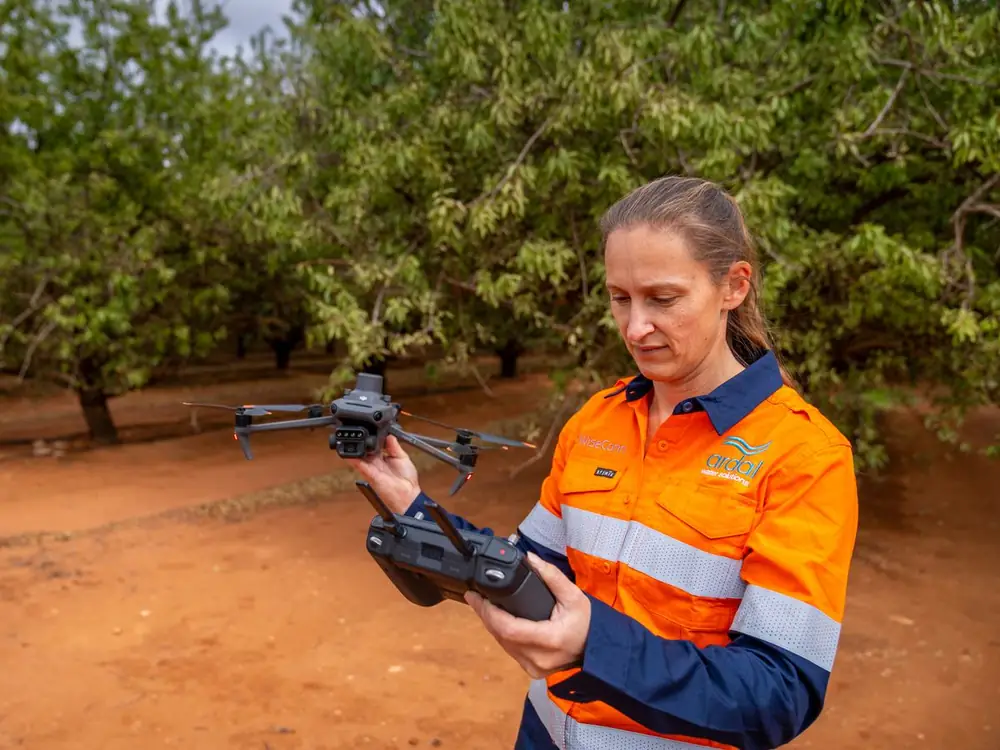
A large orchard runs many shifts a day in summer. We supply, install and service Motorola IRRInet and WiseConn automation, and come out when something stops.
- Automation supply and installation
- Servicing and call out repairs
- Run pumps and valves from wherever you are
- Data to base irrigation decisions on
Keeping a mature orchard performing
Drip systems lose performance as emitters block and pressures drift. Our field technicians check, clean and review the system, and our reports show water use by block.
- System checks and pressure maps
- Chemical cleaning of drip lines
- Staff training
- Weekly or monthly water use reports
What you get
What an almond grower or buyer gets from us.
- Water supply and security check before purchase
- Water budget and peak demand figures
- Orchard layout and drainage plan
- Drip, pump station and filtration design
- Fertigation system design
- IRRInet or WiseConn automation, installed and supported
- System reviews and pressure maps
- Water use reports by block
Free download
The Irrigation Due Diligence Checklist
12 questions to ask before you buy a horticultural property.
- Water. Entitlements and reliability, what the property actually uses, and what happens in a low allocation year.
- Infrastructure. Age and condition of the pumps, filtration and mains, and whether the system can meet peak demand.
- Soil and crop. Soil tests, drainage and salinity, and whether the crop suits the soil, climate and water.
- Risk and compliance. Frost, flood and heat exposure, and whether meters, licences and approvals are in order.
Questions
Almonds, answered.
Why do almonds need so much water?
Because a mature almond tree carries a full canopy of leaves through the hottest, driest months of a long growing season. In the Murray Valley a mature orchard typically needs about 12 to 15 ML per hectare a year, depending on climate, soil, variety and management. Rainfall covers only a small part of that, so the irrigation system has to supply almost all of it.
How often should I water my almond trees?
It depends on the growth stage, the weather and how much water your soil holds, so there is no fixed calendar. Demand climbs from spring to a peak in summer, and in the hottest weeks drip systems on light soils often run every day, sometimes in several short pulses. Most commercial growers schedule from soil moisture or tree stress monitoring and weather data, and automation runs the shifts. How much stress to allow at each stage is a question for you and your agronomist. Our job is a system that delivers the water you decide on.
What is the best type of irrigation for an almond orchard?
Drip. Almost every almond orchard in Australia is on drip, because it puts the water in the root zone with little lost to evaporation. Micro sprinklers wet a wider area and still suit some crops and soils, but for almonds the real decisions are the details: single or double lines, dripper spacing and flow, and how the orchard is split into shifts. Those come from the soil survey, the slope and the water supply, so we settle them after the survey, and specify the gear regardless of brand.
Can you check an almond orchard before we buy it?
Yes. We assess the water supply and security, the existing irrigation system, the soil and the risks, and whether the system can meet a mature orchard's peak demand. You get one independent report, written for the people making the decision.
Where do you work on almond orchards?
The team works from Mildura across Sunraysia, the Riverland and the Riverina. Field technicians are based in Sunraysia. Travel is quoted up front.
Related
Planting or buying almonds?
Send the property location and what you are planning. Nick, Matt or Aaron will call you back with a scope and a price.